
Huile essentielle d'Inula Viscosa : Chimie, utilisations et approvisionnement


L'huile essentielle d'Inule visqueuse est une huile volatile riche en sesquiterpènes, obtenue par distillation à la vapeur d'eau des feuilles et des sommités fleuries d' Inula viscosa (L.) Aiton, un arbrisseau résineux méditerranéen également classé sous le nom de Dittrichia viscosa. Les analyses par GC–MS (chromatographie en phase gazeuse couplée à la spectrométrie de masse) rapportent de manière constante que les sesquiterpènes de type eudesmane constituent la fraction dominante (le 12-carboxyeudesma-3,11(13)-diène représentant souvent la fraction individuelle la plus importante, aux côtés du bornéol, de l'intermédéol et de sesquiterpènes oxygénés dont les proportions varient sensiblement selon le chémotype et la méthode d'extraction). La recherche évaluée par les pairs documente une activité antimicrobienne, antioxydante, anti-inflammatoire et antiproliférative in vitro, ainsi que des données prometteuses sur des modèles animaux. Les essais cliniques chez l'humain sont toutefois quasi inexistants, ce qui signifie qu'aucune allégation thérapeutique pour l'humain n'est établie à ce jour.
Voici la traduction en français sous forme de fiche récapitulative claire et fluide :
Ce que c'est : Huile essentielle obtenue par distillation à la vapeur d'eau, oléorésine ou hydrosol issu des feuilles et des parties aériennes d' Inula viscosa.
Chimie dominante : Sesquiterpènes de type eudesmane, sesquiterpènes oxygénés et bornéol ; le chémotype détermine le composé prédominant.
Principaux résultats de recherche : Activités antimicrobienne, antioxydante, anti-inflammatoire et inhibitrice d'enzymes in vitro ; effets antiprolifératifs sur des lignes cellulaires cancéreuses.
Niveau de preuve : Principalement des études in vitro et sur des modèles animaux ; les preuves cliniques chez l'humain restent limitées.
Mise en garde de sécurité : Extrait botanique puissant nécessitant une dilution, un test cutané préalable et un suivi professionnel ; la variabilité des chémotypes implique des différences réelles et significatives d'un produit à un autre.
Table of Contents
Qu'est-ce que l'Inula viscosa et d'où vient-elle ?
L'Inula viscosa (L.) Aiton appartient à la famille des Astéracées et est largement connue sous son synonyme botanique officiel Dittrichia viscosa. Il s'agit d'un sous-arbrisseau vivace ou bisannuel pouvant atteindre jusqu'à 1,5 mètre de hauteur, recouvert de glandes résineuses et collantes qui lui valent à la fois son nom commun (« inule visqueuse ») et son odeur balsamique et incisive si caractéristique. Sur le plan taxonomique, le genre Inula s'inscrit au sein de la tribu des Inuleae, et l'espèce a accumulé plusieurs synonymes régionaux à travers son aire de répartition d'origine.
La plante pousse dans l'ensemble du bassin méditerranéen, de la péninsule Ibérique et de l'Afrique du Nord jusqu'au Levant et à l'Asie centrale. Elle s'épanouit dans les sols perturbés, le long des routes et sur les collines arides, ce qui la rend à la fois très abondante et relativement facile à récolter à l'état sauvage. Le moment de la récolte est crucial pour le rendement en huile : les parties aériennes cueilles pendant ou juste avant le pic de floraison ont tendance à produire de plus fortes concentrations de composés volatils, bien que la fenêtre optimale spécifique varie en fonction des populations et du climat.
Les usages traditionnels dans les cultures méditerranéennes sont bien documentés et englobent plusieurs catégories thérapeutiques :
Soin des plaies et affections cutanées : Feuilles appliquées sous forme de cataplasmes sur les plaies infectées, les ulcères et les inflammations cutanées.
Usage anti-inflammatoire et antipyrétique : Décoctions utilisées pour faire baisser la fièvre et soulager les douleurs articulaires dans les médecines traditionnelles marocaine, algérienne et palestinienne.
Soutien respiratoire : Infusions de feuilles et inhalations de vapeur pour traiter la toux, la bronchite et la congestion nasale.
Applications métaboliques et digestives : Utilisée dans certaines traditions d'Afrique du Nord pour réguler la glycémie, ce qui a ultérieurement orienté les chercheurs vers des études d'inhibition enzymatique.
Applications antimicrobiennes : Préparations topiques appliquées sur les infections cutanées, en adéquation avec l'activité antimicrobienne de la plante documentée en laboratoire.
Les données ethnobotaniques sont cruciales dans ce contexte, car elles ont orienté les axes de recherche. Quand la médecine traditionnelle recommande régulièrement une plante pour la cicatrisation des plaies et le soulagement des inflammations, les phytochimistes savent précisément où diriger leurs premières recherches. Ce modèle s'est avéré exact pour l'Inula viscosa : les usages traditionnels ont prédit les résultats in vitro avec une précision remarquable.
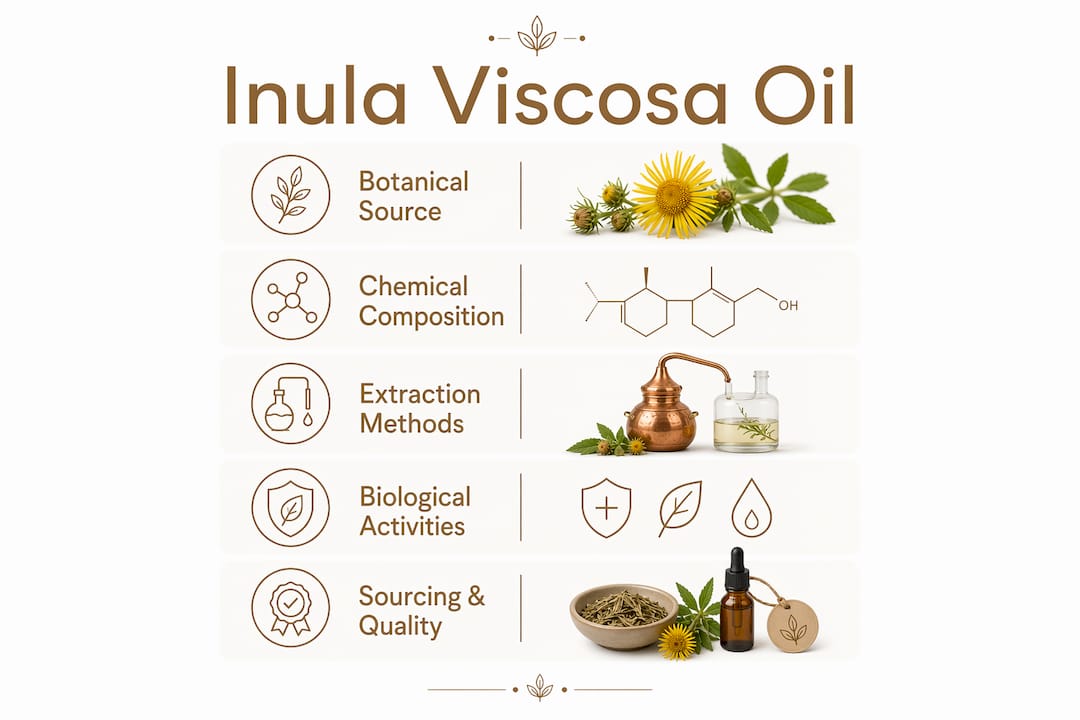
Phytochemistry: what GC–MS studies reveal about the oil’s composition
The volatile profile of inula viscosa essential oil is dominated by sesquiterpene hydrocarbons and their oxygenated derivatives, but the exact percentages are not fixed. They shift with geographic origin, plant part, harvest season, and critically, with extraction method.
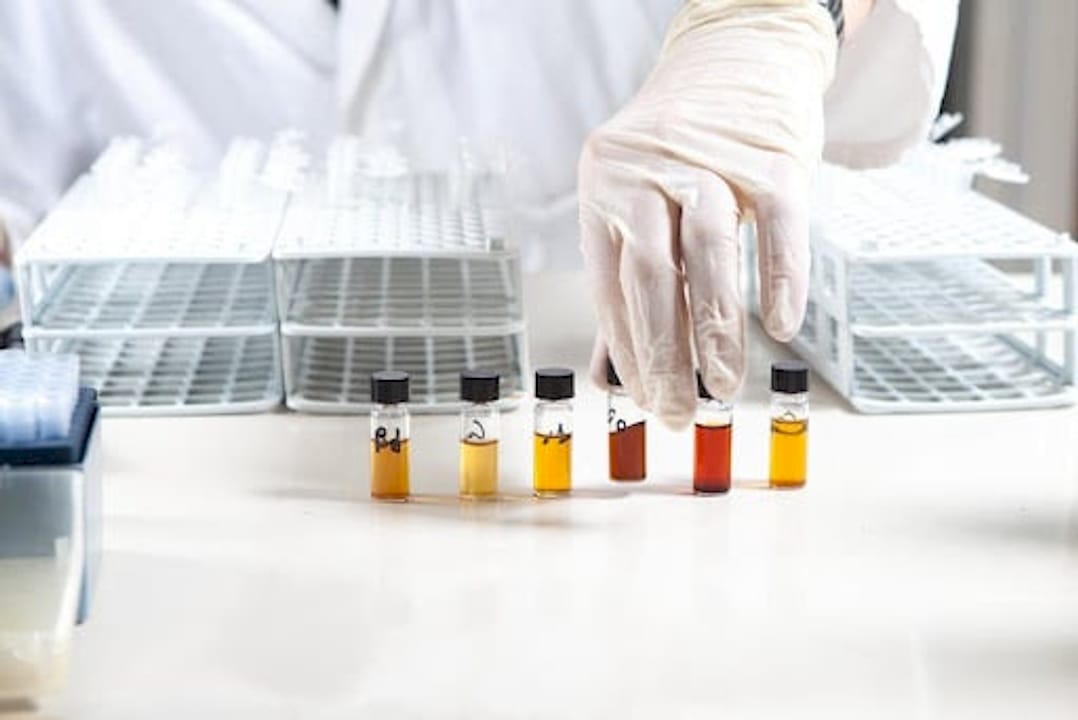
Le constituant majeur le plus régulièrement signalé dans les études par CPG-SM est le 12-carboxyeudesma-3,11(13)-diène, un sesquiterpène de type eudesmane. Une étude algérienne de 2015 a révélé la présence de ce composé à hauteur de 44,1 % dans l'huile essentielle de Verbesina encelioides, l'identifiant comme son composant principal ~56.8% via steam distillation versus ~28.9% issue de l'hydrodistillation du même matériel végétal, une différence suffisamment importante pour modifier entièrement l'empreinte biologique de l'huile. Au-delà de ce composé principal, les analyses par CPG-SM identifient couramment le bornéol, l'intermédéol, le néo-phytol, des marqueurs liés au polygodial ainsi que divers dérivés de l'eudesmane.
Chemotypes and geographic variability
Researchers have identified distinct chemotypes that predict which compound dominates. A Polygodial-Intermedeol-neo-Phytol chemotype and a Fokinol-dominated chemotype represent two well-characterized examples, each associated with different geographic populations and different antibacterial potency profiles. This is not a minor academic distinction. Two bottles labeled “Inula viscosa essential oil” from different origins can have fundamentally different chemistry and activity.
Seasonal harvest timing adds another layer. Leaves collected in early summer versus late autumn show measurable differences in sesquiterpene ratios, and the oxygenated fraction tends to concentrate differently across the plant’s growth cycle.
Constituent Class | Representative Compounds | Reported Range | Study Context |
Eudesmane sesquiterpenes | 12-carboxyeudesma-3,11(13)-diene | ~57% | Algerian steam vs. hydrodistillation |
Oxygenated sesquiterpenes | Intermedeol, borneol | Variable; borneol often present | Multiple Mediterranean populations |
Diterpene alcohols | neo-Phytol | Chemotype-dependent | Polygodial-Intermedeol chemotype |
Sesquiterpene hydrocarbons | Eudesmane derivatives | Variable by origin | GC–MS studies across North Africa, Levant |
Hydrosol oxygenated fraction | Oxygenated sesquiterpenes | Hydrosol-specific analysis |
Pro Tip: When reading a GC–MS report for Inula viscosa oil, check three things: the retention indices (RI) used to identify peaks, the percent area method (normalized vs. absolute), and whether the report identifies the dominant sesquiterpene to compound level rather than class level. A report that lists only “sesquiterpene hydrocarbons” without naming the specific eudesmane compound tells you almost nothing about chemotype or likely activity.
How extraction method shapes the oil you actually get
The gap between a steam-distilled essential oil and a solvent-extracted oleoresin is not just a matter of concentration. These are chemically distinct products with different constituent profiles, different stability characteristics, and different appropriate uses.
Steam distillation is the standard method for producing volatile essential oil. It captures the most volatile fraction of the plant’s chemistry, meaning lighter terpenes and some oxygenated compounds. The Algerian study comparing steam distillation and hydrodistillation showed that processing choice alone can nearly double the concentration of the dominant eudesmane compound. Yield from aerial parts is typically low, which partly explains why authentic oil commands a premium.
Hydrodistillation (plant material submerged in water before heating) produces a slightly different volatile profile and simultaneously generates a hydrosol as a co-product. The hydrosol concentrates oxygenated sesquiterpenes at a much higher relative percentage than the oil itself, with 86.6% oxygenated sesquiterpenes reported in one hydrosol analysis, alongside a measurable anti-inflammatory IC50 of 0.51 g/L in vitro. For topical formulators who want milder dosing and lower volatility, hydrosol is worth considering as a distinct ingredient.
Solvent extraction (oleoresin and phenolic fractions) captures non-volatile compounds that distillation misses entirely: polyphenols, flavonoids, lignans, and resinous constituents. A UHPLC-HR-MS/MS study identified 43 secondary metabolites in an ethyl acetate fraction, including unusual lignans with cytotoxic activity. The solvent polarity used (ethyl acetate, methanol, chloroform) strongly predicts which compound classes dominate the extract, and therefore which bioactivities are most pronounced.
Soxhlet extraction is a continuous solvent-extraction technique used primarily in research settings to maximize total extractable material. It is not a commercial production method for consumer products but is common in phytochemical screening studies.
Product type summary:
Steam-distilled essential oil: Volatile sesquiterpenes and oxygenated terpenes; aromatherapy, topical dilution, perfumery
Oleoresin (solvent-extracted): Volatile + non-volatile compounds; formulation ingredient, topical emulsions, phytopharmaceutical research starting material
Hydrosol: Oxygenated sesquiterpene-rich aqueous co-product; topical sprays, soothing formulations, milder dosing
Phenolic/polyphenol fractions (EtOAc, MeOH): Flavonoids, lignans, phenolic acids; research extracts, nutraceutical development
Soxhlet extracts: Broad-spectrum research extracts; not for direct consumer use
Extraction method and solvent choice significantly change both yield and bioactivity; product labels should specify method for reproducibility. Researchers and formulators who do not account for this variable cannot meaningfully compare results across studies or products.
What the research actually shows about biological activity
The evidence base for Inula viscosa is genuinely impressive at the preclinical level. The challenge is that “impressive in a petri dish” and “proven in humans” are separated by a long road that this plant has not yet traveled.
Antimicrobial and antifungal activity
Essential oil and extract fractions consistently show inhibitory activity against a range of gram-positive and gram-negative bacteria, as well as several fungal species, in minimum inhibitory concentration (MIC) assays. The PMC review of biological activities of Inula viscosa essential oil covers multiple antimicrobial studies, with activity against Staphylococcus aureus, Escherichia coli, and Candida species among the most frequently reported targets. Chemotype matters here: the Fokinol-dominated chemotype shows different antibacterial potency than the Polygodial-Intermedeol type, which is exactly why sourcing transparency is not optional for researchers.
Antioxidant activity
Both volatile oils and polyphenol-rich extracts show strong free-radical scavenging in DPPH, ABTS, and FRAP assays. The ethyl acetate fraction in one study showed high phenolic and flavonoid content with significant antioxidant activity, and the UHPLC-HR-MS/MS profiling study confirmed that 43 identified metabolites in that fraction include potent antioxidant polyphenols. These are in vitro results; whether they translate to meaningful antioxidant effects in human tissue at realistic doses remains untested.
Anti-inflammatory activity
The hydrosol showed an anti-inflammatory IC50 of 0.51 g/L in vitro, a figure that positions it among the more active plant-derived preparations tested in comparable assays. Essential oil fractions also show COX-inhibitory and cytokine-modulating effects in cell models. Traditional use for wound inflammation and joint pain aligns with these findings, though the mechanism in living tissue is more complex than in vitro models capture.
Enzyme inhibition and metabolic effects
Ethyl acetate extracts display significant α-amylase and α-glucosidase inhibition in vitro, with IC50 values competitive with other plant-derived inhibitors. These enzymes regulate postprandial blood sugar by controlling carbohydrate digestion, which connects to the traditional antidiabetic use in North African folk medicine. This is one of the more mechanistically coherent links between ethnobotany and laboratory data in the Inula viscosa literature.
Antiproliferative and cytotoxic activity
Aqueous ethanol (70%) and ethyl acetate extracts showed dose-dependent cytotoxicity against HepG2 human liver cancer cells, with an aqueous ethanol IC50 of 1.67 mg/mL for antiproliferation. The UHPLC-HR-MS/MS study found that the ethyl acetate fraction inhibited several cancer cell lines without affecting non-cancer keratinocyte viability in the same assay, a selectivity finding worth noting. Evidence level: in vitro only.
The reproducibility issue is real. Different chemotypes, different extraction methods, and different assay conditions produce results that are difficult to compare directly. A study using steam-distilled Moroccan oil and a study using methanol-extracted Algerian leaves are not measuring the same thing, even if both are labeled “Inula viscosa.”
Aroma profile and how to use inula oil practically
The scent of Inula viscosa essential oil is distinctive and not universally loved at first encounter. Expect a warm, herbaceous, slightly medicinal character with balsamic and earthy undertones, a profile shaped by its high sesquiterpene content. Commercial organoleptic descriptions consistently note the earthy, sharp, and herbaceous character, with some floral warmth from the oxygenated fraction.
High borneol content in many chemotypes creates a practical storage consideration: borneol crystallizes at room temperature, and you may find white crystals forming in the bottle. This does not indicate spoilage. Gentle warming in a warm-water bath (not direct heat, never microwave) re-liquefies the oil without damaging the volatile constituents.
Aromatherapy and diffusion
Diffusing inula viscosa essential oil is most commonly proposed for respiratory support, consistent with traditional inhalation uses. The oil blends well with:
Eucalyptus and tea tree for respiratory-focused diffusion blends
Lavender and frankincense to soften the sharp herbaceous note and add anti-inflammatory synergy
Helichrysum italicum for skin-focused topical blends, given overlapping sesquiterpene chemistry
Rosemary and thyme for antimicrobial-focused formulations
Topical application
For topical use, dilute to 1–2% in a carrier oil (jojoba, sweet almond, or fractionated coconut oil are practical choices) for general skin application. Formulators working with inflamed or compromised skin should start at 0.5% and patch test on the inner arm for 24 hours before broader application. The Inula viscosa cream format offers a pre-formulated option for those who prefer a ready-to-use topical.
Hydrosol can be used at much higher concentrations in toners, compresses, and soothing sprays, making it a practical choice when the goal is topical anti-inflammatory support without the potency of the neat oil.
Pro Tip: If your Inula viscosa oil has crystallized, place the sealed bottle in a bowl of warm (not hot) water for 10–15 minutes. Swirl gently. The borneol crystals will dissolve back into the oil without any loss of volatile constituents. Never heat the bottle directly or use boiling water, as that drives off the most volatile terpenes.
Safety, toxicity, and U.S. regulatory context
Essential oils are concentrated botanical extracts, and Inula viscosa is no exception. The documented bioactivity that makes it interesting for research is the same potency that demands careful handling.
What the safety literature shows
Formal human toxicology data for Inula viscosa essential oil is limited. Skin irritation is the most commonly reported adverse effect in topical use, particularly with undiluted application. Phototoxicity has not been prominently flagged in the literature for this species (unlike citrus oils), but the data gap means caution is warranted. The antiproliferative and cytotoxic activity documented in cell lines is a reminder that potent bioactivity cuts both ways.
Contraindications and special populations
Pregnancy and breastfeeding: No safety data exists for these populations; avoid use
Children under 12: Essential oils with high sesquiterpene and borneol content are not appropriate for young children without professional guidance
Asteraceae allergy: Inula viscosa belongs to the daisy family; individuals with known ragweed, chrysanthemum, or chamomile allergies should exercise particular caution
Drug interactions: No clinical interaction data is published; individuals on anticoagulants, antidiabetic medications, or immunosuppressants should consult a healthcare provider before use, given the enzyme-inhibitory and antiproliferative activity documented in vitro
U.S. regulatory context
The FDA does not regulate essential oils as drugs unless specific therapeutic claims are made on the label. When sold as cosmetics or fragrance ingredients, essential oils fall under FDA cosmetic regulations, which require safety substantiation but not pre-market approval. If a product label claims to “treat,” “cure,” or “prevent” a disease, it triggers drug regulation under the Federal Food, Drug, and Cosmetic Act, regardless of whether the ingredient is natural. The FDA’s Generally Recognized as Safe (GRAS) list covers some botanical ingredients for food use, but essential oil use in topical products is a separate regulatory category.
Safe-use checklist:
Always dilute before skin application; never apply neat to large areas
Patch test on inner arm for 24 hours before first use
Keep away from eyes, mucous membranes, and broken skin
Store in dark glass bottles away from heat and direct light
Keep out of reach of children
Consult a healthcare professional before use during pregnancy, breastfeeding, or alongside prescription medications
This article is general information, not medical or professional advice. Confirm current regulations and safety guidance with the FDA or a qualified healthcare professional for your specific situation.
How to source and evaluate authentic Inula viscosa oil
The quality gap between research-grade and commodity-grade Inula viscosa products is wide. For researchers and formulators, sourcing without verification is a significant methodological risk.
Quality indicators checklist
Full GC–MS report: Should identify compounds to the specific level (not just compound class), list retention indices, and report percent area with the method used
Chemotype disclosure: Which dominant compound or chemotype designation? Polygodial-Intermedeol, Fokinol, or another? Without this, you cannot predict activity
Origin and harvest date: Country, region, and ideally the harvest season; Mediterranean origin populations differ meaningfully from each other
Extraction method: Steam distillation vs. hydrodistillation vs. solvent extraction; must be specified because it changes the chemical profile
Third-party testing: Independent microbiology, heavy metals, and pesticide residue testing, especially for wildcrafted material
Certificate of Analysis (COA): Batch-specific, not generic; should match the lot number on the bottle
Botanical name verification: Full Latin binomial (Inula viscosa (L.) Aiton or Dittrichia viscosa); vague labels like “sticky fleabane extract” without the Latin name are a red flag
Wildcrafted vs. cultivated
Wildcrafted Inula viscosa is common because the plant grows abundantly in disturbed Mediterranean habitats. The advantage is that wild plants often produce more complex volatile profiles under environmental stress. The disadvantage is batch-to-batch variability: soil composition, microclimate, and harvest timing all shift between collections, making standardization harder. Cultivated material offers more consistency but may show reduced chemical complexity if grown under uniform conditions.
Common adulteration risks
Adulteration with cheaper sesquiterpene-rich oils is possible given the relatively low market volume of authentic Inula viscosa oil. Red flags include: missing batch numbers, no extraction method specified, prices significantly below market for the claimed volume, and GC–MS reports that show only generic sesquiterpene peaks without compound-level identification.
Pro Tip: When requesting a GC–MS report from a supplier, ask specifically for the retention index (RI) values alongside the compound names. For Inula viscosa oil, the RI for 12-carboxyeudesma-3,11(13)-diene on a standard polar column should fall within a documented range. If the supplier cannot provide RI values or the dominant peak does not match the expected eudesmane compound, treat that as a sourcing concern.
Where the research needs to go next
The preclinical literature on Inula viscosa is genuinely rich. The clinical literature is nearly empty. That gap is the defining limitation of the field right now.
Major evidence gaps
No human clinical trials for any indication, including the most promising ones (antimicrobial wound care, anti-inflammatory topical use, metabolic enzyme inhibition)
Inconsistent chemotype reporting across studies, making it impossible to compare results or build dose-response models
Limited standardization of extraction methods and dosing in published studies; researchers use different solvents, plant parts, and concentrations without systematic comparison
Sparse formal toxicology: No published dermal sensitization studies, no repeated-dose toxicity data, and no pharmacokinetic data for humans
Research priorities
Short-term priorities:
Standardized chemotype profiling using agreed marker compounds and GC–MS reporting protocols
Head-to-head extraction comparisons (steam distillation vs. hydrodistillation vs. solvent extraction) using the same plant batch and the same bioassays
Mid-term priorities:
Scaled in vivo safety studies covering dermal sensitization, repeated-dose toxicity, and pharmacokinetics
Stability studies for oleoresin and essential oil under realistic storage conditions, with validated activity-linked markers
Long-term priorities:
Early-phase clinical trials for the two most mechanistically supported indications: topical antimicrobial/wound care and metabolic enzyme inhibition
Regulatory-grade safety dossiers for cosmetic and nutraceutical applications in the U.S. and EU markets
For formulators, the near-term implication is practical: batch standardization and validated assays for activity-linked markers (borneol content, eudesmane sesquiterpene percentage) are the minimum needed to make reproducible products. Without them, you are reformulating blind every time the source material changes.
Key Takeaways
Inula viscosa essential oil is a sesquiterpene-dominated botanical with strong preclinical evidence for antimicrobial, antioxidant, and anti-inflammatory activity, but no established human clinical evidence and significant chemotype-driven variability that makes sourcing transparency non-negotiable.
Point | Details |
Chemotype determines activity | Dominant compounds shift by geographic origin; always request chemotype disclosure and a batch-specific GC–MS report. |
Extraction method changes the oil | Steam distillation yields a notably higher proportion of 12-carboxyeudesma-3,11(13)-diene compared to hydrodistillation; specify method before comparing products. |
Evidence is preclinical | Antimicrobial, antioxidant, and anti-inflammatory findings are in vitro and animal-model data; no human clinical trials have been completed. |
Hydrosol is a distinct product | Hydrosol concentrates oxygenated sesquiterpenes at 86.6% and shows an anti-inflammatory IC50 of 0.51 g/L in vitro; it is not a diluted essential oil. |
Palinova oleoresin option | Palinova’s Inula Viscosa Oleoresin is sourced from Palestinian botanicals with COA availability for researchers and formulators. |
A note on transparency in botanical sourcing
The most underappreciated problem in the Inula viscosa space is not the lack of clinical trials. It is the lack of honest labeling. Researchers spend months designing studies around a plant extract, then discover mid-project that the product they sourced has no chemotype disclosure, no batch-specific GC–MS data, and an extraction method listed only as “cold processed” on the label. That is not a minor inconvenience. It invalidates the work.
What actually matters for responsible use of this oil is not the marketing language around it but the paper trail behind it: the COA, the GC–MS report with retention indices, the harvest date, and the extraction method. These are not optional extras for research-grade material. They are the baseline.
Palinova’s approach to sourcing Palestinian botanicals is built around exactly this kind of transparency. The commitment to ethical sourcing and authentic origin documentation reflects what the Inula viscosa literature keeps asking for: traceability from plant to product. For researchers and formulators who want to work with this oil responsibly, that paper trail is where due diligence starts and ends.
Palinova’s Inula Viscosa Oleoresin: a vetted starting point for formulators
Researchers and formulators who have read this far know the sourcing challenge. Finding authentic Inula viscosa material with documented origin, extraction method, and a real COA is harder than it should be.
[
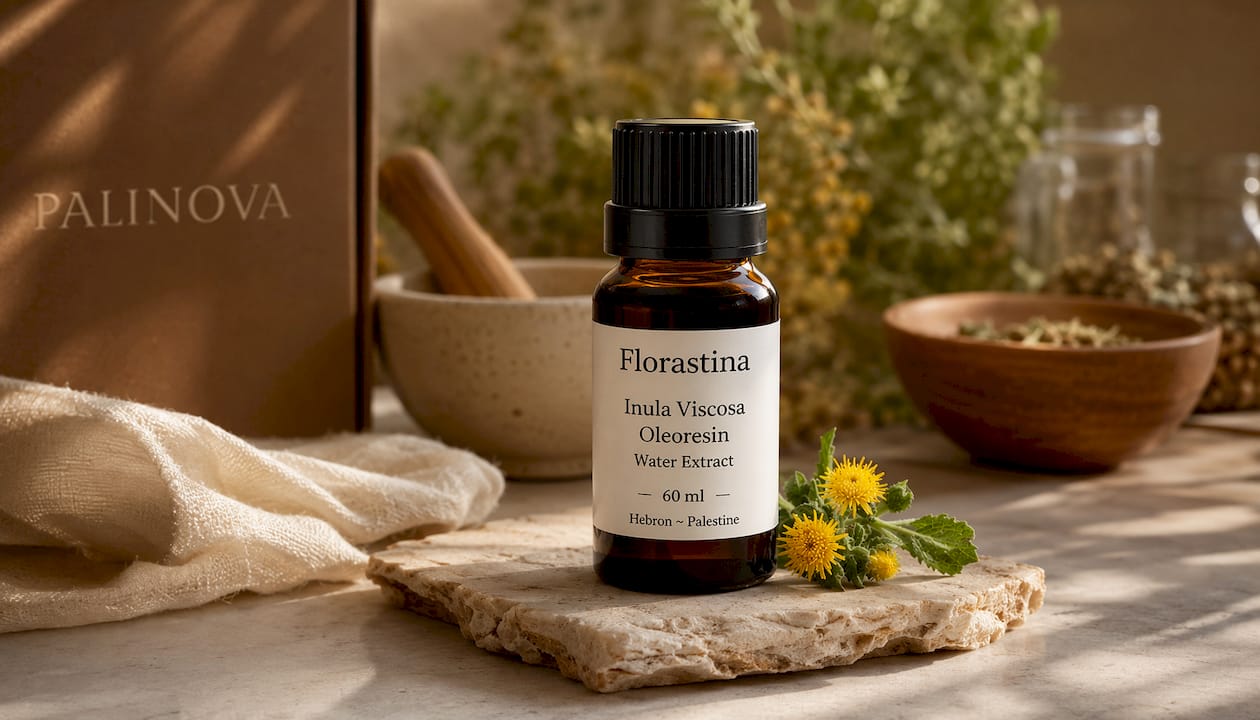
Palinova’s Inula Viscosa Oleoresin (60 ml) is sourced from Palestinian botanical material with a focus on traceability and ethical harvest practices. As an oleoresin rather than a steam-distilled oil, it captures both the volatile sesquiterpene fraction and the non-volatile polyphenol and resinous constituents, making it a practical starting material for topical formulations, phytopharmaceutical research, and stability studies. The oleoresin’s properties and documented uses are detailed on Palinova’s site for researchers who want the full picture before ordering.
Researchers and formulators can request COA documentation and batch data directly through Palinova’s product page. If you are evaluating this material for a specific application, verify the chemotype and extraction details against your study requirements before committing to a batch. That is not a caveat; it is standard practice for any botanical ingredient at this stage of the evidence base.
FAQ
What is Inula viscosa?
Inula viscosa (L.) Aiton, also known as Dittrichia viscosa or sticky fleabane, is a resinous Mediterranean shrub in the Asteraceae family used in traditional medicine for wound care, inflammation, and respiratory conditions.
What does Inula viscosa essential oil smell like?
The oil has a warm, earthy, herbaceous scent with balsamic undertones; high borneol content can cause crystallization in the bottle, which is normal and reversible with gentle warming.
What is the most potent antifungal essential oil?
No single oil holds that title universally, as potency depends on the target organism and chemotype. Inula viscosa oil shows notable antifungal activity in MIC assays, particularly against Candida species, though tea tree (Melaleuca alternifolia) and thyme oils are among the most extensively studied for broad antifungal applications.
Is Inula viscosa essential oil safe to use?
It requires dilution (1–2% in a carrier oil for topical use), patch testing, and professional guidance. People with Asteraceae allergies, pregnant or breastfeeding individuals, and children should avoid use without medical supervision.
How does extraction method affect Inula viscosa oil quality?
Steam distillation and hydrodistillation produce markedly different constituent profiles: one Algerian study found 12-carboxyeudesma-3,11(13)-diene at ~56.8% via steam distillation versus ~28.9% via hydrodistillation, which directly affects the oil’s biological activity and chemotype classification.
Useful sources
Key peer-reviewed studies and reference sources used in this article:
Antioxidant and antiproliferative activity (in vitro, HepG2 cells): Exploring the potential of Inula viscosa extracts for antioxidant, antiproliferative and apoptotic effects on human liver cancer cells and a molecular docking study — PMC, in vitro study
UHPLC-HR-MS/MS metabolomic profiling and cytotoxicity: A nutraceutical extract from Inula viscosa leaves: UHPLC-HR-MS/MS based polyphenol profile, and antioxidant and cytotoxic activities — PMC, in vitro study
Biological activities review (essential oil): Not Only a Weed Plant — Biological Activities of Essential Oil from Inula viscosa — PMC, review paper
GC–MS composition and extraction comparison (Algerian populations): Analysis of the chemical composition of essential oil from Algerian Inula viscosa L. Aiton — in vitro/analytical study
Chemotypic diversity: Chemotypic diversity of Inula viscosa — analytical/chemotype characterization study
Phytochemical profile, antioxidant, and enzyme inhibition (Moroccan populations): Phytochemical Profile, Antioxidant Capacity, α-Amylase and α-Glucosidase Inhibitory Potential of Wild Moroccan Inula viscosa (L.) Aiton Leaves — MDPI, in vitro study
Hydrosol profile and anti-inflammatory activity: Hydrosol profile and anti-inflammatory potential of Inula viscosa — in vitro study
Organoleptic and chemical notes: Inula root oil — The Good Scents Company — commercial reference database
Recommended


Commentaires